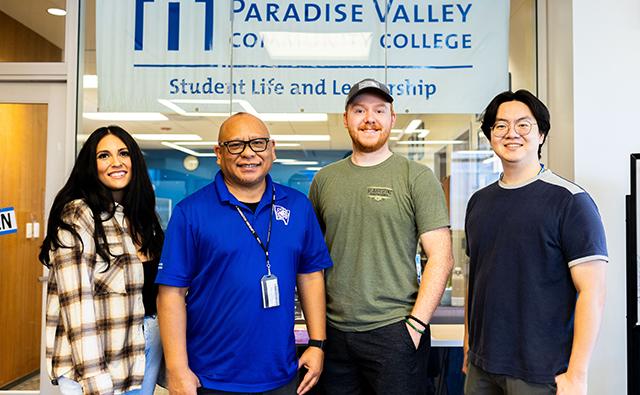





About Paradise Valley Community College
Paradise Valley Community College (PVCC) is a dynamic and student-centered institution located in Phoenix, Arizona. As part of the Maricopa County Community College District, one of the largest community college systems in the nation, PVCC is committed to transforming lives through learning, service, and leadership. The college offers more than 125 degree and certificate programs, including 37 associate degrees and 46 certificate options available, and more than 150 academic pathways organized by Fields of Interest to help students align their educational journey with career goals. These programs empower students to transfer to four-year universities, enter the workforce, or pursue lifelong learning. In addition to associate-level offerings, PVCC now offers two bachelor’s degree programs: a Bachelor of Arts in Elementary and Special Education and a Bachelor of Business Administration in Accounting. The college supports strong transfer partnerships with Arizona State University, Northern Arizona University, the University of Arizona, and Grand Canyon University, providing students with seamless transfer pathways toward completing a four-year degree. PVCC’s Honors Program offers a rigorous academic experience for high-achieving students seeking greater intellectual engagement and leadership development. Among the college’s most popular programs are Liberal Arts and Humanities, Nursing, EMT/Paramedic, Business Administration, and the Arts— reflecting a diverse student body with varied academic and professional interests. PVCC fosters a vibrant and inclusive campus culture that supports the whole student. A robust network of student services includes academic and career counseling, tutoring, disability resources, veteran services, and dedicated support for first-generation college students.
The college encourages student involvement through intercollegiate athletics—competing in 12 NJCAA sports programs as the proud home of the Pumas—as well as a variety of clubs, activities, and leadership opportunities. Campus amenities include a modern library, Center for the Performing Arts, fitness center, and on-site café, all of which contribute to a welcoming and engaging environment. PVCC also prioritizes early college access through initiatives like Dual Enrollment, enabling high school students to earn college credit or even an associate degree before graduation.
PVCC is accredited by the Higher Learning Commission (HLC), with its accreditation most recently reaffirmed in 2024. The college maintains an open admissions policy, ensuring broad access to quality higher education.
PVCC is currently looking for its next Vice President of Academic Affairs.
Vice President of Academic Affairs Position Overview
The next Vice President of Academic Affairs of PVCC will be a visible, transparent, courageous, and visionary leader who has a demonstrated history of success, leads with impact, builds trust, and leads the College in addressing the following opportunities and challenges through the a shared governance framework:
Prioritize Institutional Stability and Academic Program Success
- Address leadership fatigue by modeling consistency, reliability, and long-term commitment to institutional priorities through leading with a long-term vision that ensures stability and sustained institutional success, demonstrating commitment to seeing initiatives through from development to completion.
- Evaluate the full institutional impact of program expansion, including financial sustainability, resource allocation, and effects on existing programs.
- Implement and sustain a comprehensive Academic Master Plan that prioritizes student learning, program quality, and institutional effectiveness.
- Foster strong community partnerships and workforce pipelines to ensure programs remain relevant and responsive to evolving regional needs.
- Promote ethical and effective integration of emerging technologies (e.g., AI) by establishing clear guidelines, training, and academic integrity standards.
- Operate as a systems thinker and advocate for college needs and academic interests through systems work
- Stay attuned to community needs and trends, adapting programs and services to reflect evolving demographics and workforce demands.
- Advocate for sustainable investment in infrastructure, ensuring that classrooms, labs, and digital systems adequately support instruction and student services.
Adapt to Changes in Funding, Expand Resource Allocation
- Ensure existing programs are financially and operationally sustainable through clear plans for growth, remediation, or redesign, while equitably and strategically allocating resources for innovation and new programs.
- Provide exemplary stewardship of financial resources, ensuring transparency, accountability, and alignment with institutional priorities.
- Navigate volatile federal and state funding environments by proactively identifying risks and developing contingency strategies.
- Champion innovative solutions to modernize infrastructure while maintaining fiscal responsibility.
- Strengthen grant acquisition and management capacity, including long-term planning for initiatives such as multi-year grants (e.g., Aspen-related efforts) to ensure sustainability beyond initial funding periods
Increase Enrollment and Foster a Learning and Community Centered Environment
- Support and execute strategic enrollment management plans that address demographic shifts, including the enrollment cliff and changing community populations, while ensuring responsible and context-driven use of enrollment data.
- Affirm a learning-centered philosophy that emphasizes teaching quality and student achievement.
- In partnership with Student Affairs, enhance dual enrollment and early college pathways.
-
Advance and oversee strategic program growth, ensuring new and existing programs are aligned with labor market demand and lead to living-wage outcomes for students.
Enhance Shared Governance and Leadership Efforts
- Through enhanced shared governance structures, demonstrate a collaborative leadership style, breaking down silos and promoting cross-functional cooperation across departments.
- By working collaboratively with all constituency groups strengthen communication and trust by consulting stakeholders regularly and valuing input from both new and experienced faculty and staff.
- Promote a culture that values new and experienced faculty and staff by modeling respect, transparency, and inclusive shared governance.
- Ensure faculty, staff, and leadership are engaged early and meaningfully in decision-making processes.
- Support and develop faculty and staff, including improving evaluation processes to recognize excellence and encourage professional growth.
- Ensure division chairs and academic leadership are active participants in the planning and implementation process.
Ideal Characteristics for PVCC's Next VPAA
The ideal candidate needs to be an adaptable, collaborative, and finance-savvy leader who is deeply student-focused and a strong advocate for Academic Affairs.
- A transparent, collaborative, and bridge-building leader committed to shared governance who addresses difficult issues with integrity, fosters trust, and maintains strong collaborative relationships across all levels of the college community.
- Experienced in multi-campus and district-level academic environments, with the ability to lead across complex organizational structures.
- Proven record of building and sustaining community and industry partnerships that strengthen academic and workforce pathways.
- Extensive experience managing large and complex academic budgets, with strong fiscal stewardship and strategic resource allocation skills.
- Data-informed and analytical decision-maker who critically evaluates data while integrating qualitative insights, institutional context, and community perspectives, guided by high emotional intelligence that balances evidence, operational realities, and human impact.
- Technologically forward-thinking leader, comfortable with emerging tools such as artificial intelligence and their implications for teaching and learning.
- A visionary and innovative leader who balances creative problem-solving with sound operational judgment, advancing the college to its next level while maintaining operational excellence, student focus, and respect for institutional history and culture.
- Committed to long-term institutional growth, dedicated to sustained leadership and follow-through on initiatives.
- Community and student-centered leader who understands and is deeply connected to the institution’s service region and mission.
- Highly detail-oriented and conscientious, ensuring accuracy, accountability, and excellence in academic operations.
- Approachable and grounded leader, who leads with humility, listens before acting, and builds understanding of existing structures before implementing change.
Qualifications
Master’s Degree from a regionally accredited institution and four years of progressively responsible management and/or leadership experience in the field of assignment that includes two years of supervisory experience. Examples of academic support management/leadership experience includes: program management, project management, budget development and management related to programs or projects, staff supervision, policy development, administration, evaluation, and compliance. Equivalency allowed.
- A doctorate degree
- 5 years of full-time undergraduate teaching experience
- Full-time teaching experience at a community college
- 5-7 years of academic affairs leadership experience (i.e., department/division chair, dean, faculty leadership)
- Experience in a multi-college system
- Experience with accreditation (discipline or college)
- Demonstrated use of strategies in conflict resolution and facilitation
- Examples of commitment to the core principles of the professoriate: shared governance, academic freedom, and peer review
How To Apply
This is a confidential search process. To ensure full consideration, application materials should be received no later than September 8, 2026. The position will remain open until filled.
To apply go to http://www.acctsearches.org and upload your documents.
Candidates will need to have the following information or materials available to complete the application:
- A letter of application (not to exceed 5 pages) that succinctly addresses the opportunities and challenges identified in the Position Profile and demonstrates how the candidate’s experience and professional qualifications prepare them to serve as the Vice President of Academic Affairs, Paradise Valley Community College.
- A current resume including an email address and cellular telephone number.
- A list of eight references: example, two to three supervisors, two to three direct reports, and two to three faculty and/or staff members from current and former institutions.
For additional information, nominations, or confidential inquiries, please contact: Dr. Cecilia Cervantes, at [email protected] or (651) 795-1992