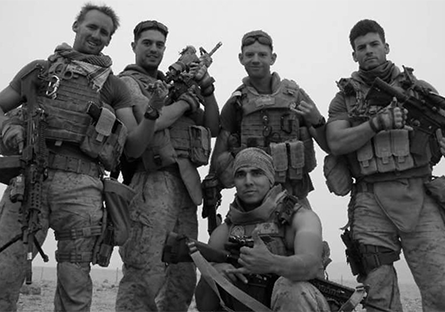
From the battlefield to the backstage, Paradise Valley Community College Fine and Performing Arts faculty member Ryan Wentzel has always thrived where problem-solving meets creativity. A Marine Corps veteran who served tours in Africa, Afghanistan, and Mexico, Wentzel now channels his military mindset into the arts at PVCC. Whether teaching students how to light a stage, build a set, or capture 3D models in PVCC’s Innovation Center, he blends his passion for theater with the precision and adaptability he learned as a reconnaissance marine.
Wentzel’s journey with PVCC began in 2007 when he enrolled in the college’s Emergency Medical Technician (EMT) program before deploying to Afghanistan. Upon returning from the battlefield, he realized he missed the arts having grown up with a love for performance, music, and dance; switching his major to Fine Arts was a decision, he says, “changed my life.”
In 2010, Wentzel began working in PVCC’s Center for the Performing Arts (CPA) while still a student. After earning his Associate of Applied Science degree in Technical Theater and Performing Arts, he started at the ground level, advancing through nearly every technical role from master carpenter and electrician to first technician, assistant technical director, and later technical director. His leadership continued to expand as he became director of production and program director of technical arts. Today, Wentzel teaches three courses – basic lighting, technical theater, and 3D scanning and photogrammetry, while also continuing to mentor students at various campus events and also in the Innovation Center.
“Ryan has grown from a PVCC student into a leader who brings creativity, discipline, and innovation to everything he does,” said Fine and Performing Arts Division Chair Dr. Chris Scinto. “His passion for teaching and mentoring students has made a huge impact on our programs, and we’re lucky to have him on our team.”
Additionally, Wentzel continues his service in the Marine Corps Reserves as a Reconnaissance Marine, bringing the lessons of military life into the classroom.
“Adapt, improvise, and overcome” has been his motto in the military for 20 years; today, he instills the same mindset in his students. Just as reconnaissance missions require problem-solving, planning, and improvisation, such as using drones to gather intel or analyzing terrain, Wentzel encourages students to approach stagecraft with the same discipline and creativity.
“I get students to look at it through this lens, help them dissect the project, and problem solve, whether it’s building a set, designing lighting, or creating special effects,” he said. “I encourage them to not be limited by limitations in front of them. If they see limiting factors, look beyond it.”
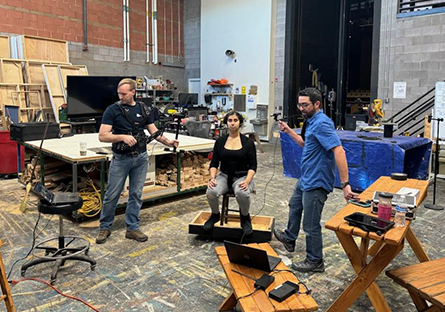
Most recently, Wentzel has collaborated with PVCC Ceramics faculty Frank Krevens to expand the use of photogrammetry in the arts, which is the science of creating accurate 3D models from multiple overlapping photographs taken at different angles. Alongside 3D scanning, photogrammetry allows physical objects and environments to be digitally captured and preserved. Widely used in fields like surveying, archaeology, forensics, and game design, and even the military, these techniques have become powerful tools for both education and creative industries.
Inspired by an article he read in which the Notre Dame in France was being 3D scanned for a video game, Wentzel and Krevens wanted to apply this technology to their own needs. The two have done so in imaginative ways – recycling and digitally modeling broken theater props, as well as scanning and preserving artwork across campus building virtual galleries that make PVCC’s collection accessible to a wider audience. These works can be explored through PVCC’s 3D Galleries:
“I want to give my students as many tools as they can possibly have to be successful,” Wentzel said. “Our goal is to build the bridge between STEM (science, technology, engineering, mathematics) with the art aspect for STEAM.”
Krevens agreed, saying, “I see these technologies as transformative not only for the arts but for all disciplines. I’m excited by the potential that lies ahead as we place these tools and skill sets in the hands of our students. The implications of 3D scanning and photogrammetry reach far beyond any single discipline; every area of study can find meaningful ways to engage with this. This technology opens new possibilities for collaboration across art, design, engineering, entrepreneurship, and science; it gains even greater depth when combined with emerging tools.
He added that integrating artificial intelligence (AI) can act as a bridge between disciplines, empowering students and faculty alike to explore new territory, explaining that “AI can serve as a bridge between disciplines, helping faculty and students explore unfamiliar territory, such as an art faculty member using it to generate working code and scripts so that their curiosity is guided rather than stalled. In this way, AI becomes a middle ground that connects curiosity with expertise, encouraging collaboration across departments and fields of study.
“By designing and building much of our own setup, Ryan and I model the spirit of experimentation, innovation, and collaboration,” Krevens said. “Our initiative could be a hub of a larger wheel of creativity on campus; a true STEAM space; where each discipline forms a spoke connected through shared curiosity, craftsmanship, exploration and discovery.”
For Wentzel, the greatest reward has been passing his knowledge on to the next generation. “It’s been fulfilling to go out into the community, bring back my experience, and help set students up for success,” he said.
To learn more about PVCC’s Fine and Performing Arts program, visit the website.